Most newsletter platforms give you a dashboard after every send: open rate, click rate, link performance, engagement scores, and sometimes a profile of what each subscriber has done.
But what if you don't want any of that?
Maybe you don't want to track what individual subscribers do in their inboxes. Maybe you're using a newsletter platform that doesn't offer open or click tracking. Or maybe you simply don't think following your readers' behavior is necessary to run a good newsletter.
That creates an uncomfortable question:
If I can't see who opened or clicked, how do I know anybody is listening?
This article shows you how to run a newsletter without tracking opens or clicks, and still know whether it's working.
The goal isn't to stop measuring your newsletter. It's to stop relying on invisible behavioral tracking as the primary way of understanding your audience.
Instead, you can build a newsletter around three things: privacy, direct feedback, and explicit signals.
You can still measure whether your newsletter is reaching people, learn what readers want, and periodically clean up subscribers who no longer want to hear from you, all without tracking individual opens and clicks.
Why avoid open and click tracking?
Open and click tracking became standard because they make email feel measurable.
You send 10,000 emails and get numbers back:
4,200 opens620 clicks180 highly engaged subscribersThose numbers are convenient. But convenience isn't the same as necessity.
An open isn’t the same as reading
Traditional open tracking uses a remote image embedded in the email. The image URL can contain information that identifies the recipient or campaign. When the image is requested, the sender can record an open.
But an image request isn't the same thing as a person reading an email.
Modern email clients and security systems can fetch remote content automatically. Apple Mail Privacy Protection goes further: Apple says it prevents senders from seeing whether and when a recipient opened an email and hides the recipient’s IP address from the sender.
Google’s own sender guidelines also explicitly say it does not track open rates and cannot verify the accuracy of open rates reported by third parties.
So, an open rate was never a direct measurement of reading. It was an inference, and an increasingly unreliable one.
Click tracking tells you more, but still not everything
Click tracking typically replaces a normal destination URL with a redirect that can identify the campaign and, depending on the implementation, the individual subscriber. The platform records the click and then sends the reader to the destination.
A click is a stronger behavioral signal than an open, but it still doesn't explain the behavior.
Someone clicked because they found it useful, were curious, clicked accidentally, disagreed, or just wanted to see where it went. The number tells you what happened. It doesn't tell you why.
Tracking also creates a privacy question
Subscriber-level tracking collects information about an identifiable person's behavior, in an unusually personal environment.
The legal picture isn’t as simple as “GDPR makes email tracking illegal.” GDPR governs how personal data is processed and requires a lawful basis, transparency, and data minimization. The European Commission notes legitimate interests can sometimes justify direct marketing, but organizations still have to inform people and weigh the impact on their rights. Separately, the ePrivacy framework governs accessing information on a user’s device.
That distinction became relevant in 2026. France’s CNIL published a recommendation on email tracking pixels in April 2026, stating that pixels used to measure campaign performance or build recipient profiles generally require prior consent, with narrower exemptions. Italy’s Garante published its own guidance in the same month, emphasizing transparency, consent, and privacy by design.
These rules are jurisdiction-specific and shouldn’t be reduced to “tracking is illegal now.” But the direction is clear: invisible email tracking is no longer a neutral default.
There's a simpler alternative. Don't collect the behavioral signal in the first place.
You don’t need tracking to listen to readers
Removing tracking creates a different problem. If you can’t see opens and clicks, you might feel like you’re sending emails into a void.
The answer isn’t to recreate the same tracking through another mechanism. It’s to create feedback channels.
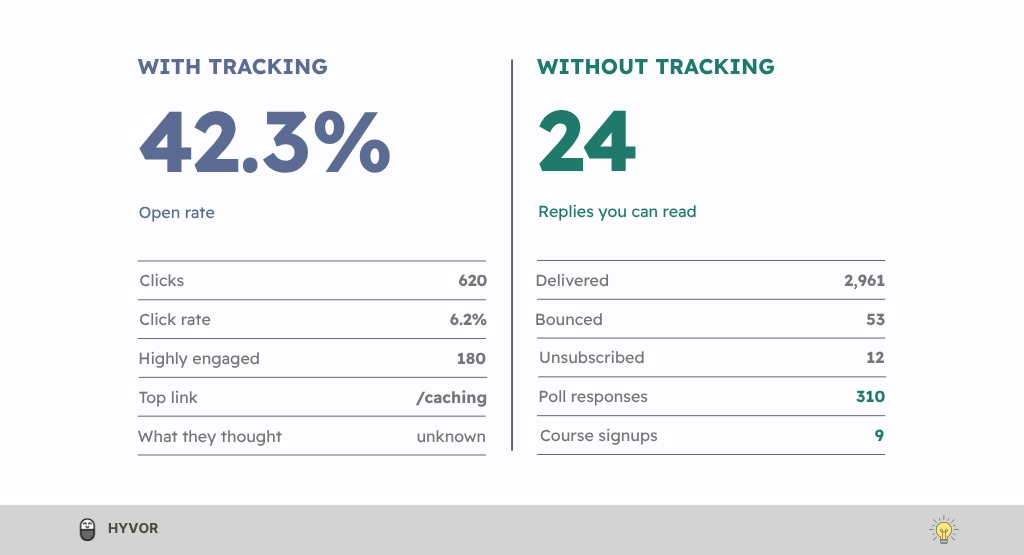
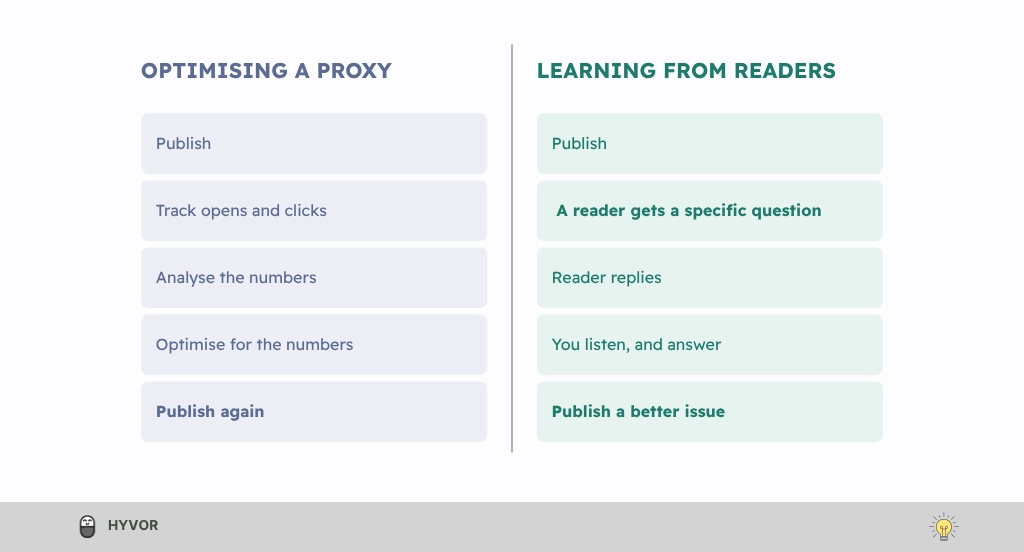
A tracking system might tell you that 38% of recipients apparently opened an issue. A reader who replies:
“The caching section was useful, but I still don’t understand invalidation.”
has given you something much more actionable. They’ve also given you your next topic.
That’s the fundamental shift: replace inferred engagement with intentional feedback.
This isn’t only a theory. Copywriter Sally Fox turned tracking off on her own newsletter and wrote about the decision in two places: on her site, Lumen & Fox, and for ProCopywriters. Both credit advice from the Below Radar community if you want to know whether anyone’s out there, invite them to reply. She reported more replies, more shares, and a stronger sense of connection to readers than a percentage on a dashboard ever gave her.
Make replies your primary feedback channel
If you take one thing from this article, make it this:
The single most effective feedback mechanism is inviting replies, and meaning it.
Replies are one of the most useful feedback mechanisms available to a newsletter that doesn’t track opens or clicks. A reader has to decide that something is worth saying and then actually say it.
Compare “42% opened this issue” with “I’ve been trying to understand this exact problem for months. Could you explain how it works with PostgreSQL?”
The second one tells you what your reader needs.
Specific questions get replies
“Let me know what you think” sounds like a feedback request, but it puts all the work on the reader, since it never says what’s actually worth mentioning. A specific question does that work instead.
Weak | Any feedback? Just hit reply. |
Better | Was the section about cache invalidation clear? If not, reply and tell me where I lost you. |
Even better | What are you currently struggling with? I’m choosing next week’s topic from reader replies. |
The easier the question is to answer, the more likely someone is to answer it.
Make replying actually possible
If your From address is noreply@example.com, you’ve already told the reader the conversation is closed. Use a real address.
And when someone replies, read it. A short “Thanks, that’s a good point. I’ll cover it in a future issue” is enough. The point is to demonstrate the invitation was genuine.
Build a reply culture
Feedback works better when readers know that someone is actually listening. Most people have received thousands of newsletters and marketing emails where replying feels pointless. Changing that expectation takes repetition.
Invite replies consistently.
Answer them.
Use reader questions in future issues.
Occasionally publish a mailbag issue based on questions you’ve received.
Over time, readers learn: if I reply, something can happen.
Use polls, reactions, and surveys when a reply isn’t necessary
Replies are excellent for qualitative feedback, but sometimes you only need a simple answer. You can count the results without necessarily building a profile of which subscriber selected which option. The same idea can work for simple reactions.
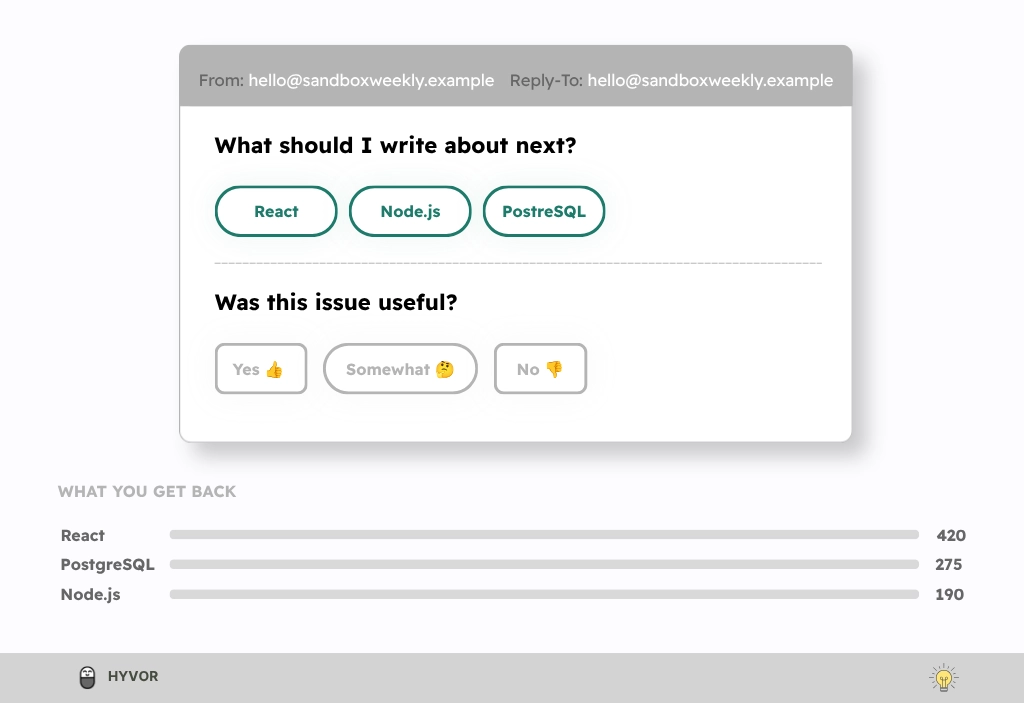
The important distinction is aggregate feedback versus subscriber-level behavioral tracking. If the implementation assigns every subscriber a unique identifier and lets you connect the response back to them, you’ve moved back toward individual tracking. If you’re only collecting an aggregate count, you’re asking the audience a question rather than building a behavioral profile. (If you're on Hyvor Post: native in-newsletter polls aren't available yet, but they're on the way. 🛠️)
Use surveys for broader questions:
What topics do readers want more of?
How often should the newsletter be sent?
What format do readers prefer?
What should you stop doing?
What problems are readers currently trying to solve?
A good survey once or twice a year can tell you more about what your audience wants than months of open-rate data. But surveys work best sparingly, saved for the moments when a survey is genuinely the right tool for the question.
How do you know whether the newsletter is working?
Once you stop looking at opens and clicks, it's no longer whether someone opened the email, it's whether the issue accomplished what it was supposed to accomplish.
For a personal newsletter, success might mean:
readers reply with questions,
readers recommend the newsletter,
the subscriber base grows,
readers tell you what they want next.
For a newsletter attached to a product, it might mean:
website visits,
signups,
purchases,
bookings,
downloads.
For a publication, it might mean:
subscriber growth,
reader feedback,
aggregate article traffic,
referrals.
The goal is to measure outcomes, not every action that happened on the way there.
Measure business outcomes without tracking individual clicks
Suppose your newsletter promotes a course. You don't need to know which 1,283 subscribers opened the email. You need to know how many registrations came from the newsletter:
Newsletter → Landing page → Course signup
Use a shared campaign URL, a dedicated landing page, or a promotion code. You learn Issue 42 → 17 course signups without creating Subscriber #1847 → clicked → visited → signed up.
In practice, this usually means adding the same campaign identifier to the links in an issue, a standard UTM tag (?utm_source=newsletter&utm_campaign=issue-42) or a simpler first-party one (?source=newsletter), then read the results in a privacy-first analytics tool such as Plausible, Fathom, or Umami. Every subscriber gets the identical link, so you learn how the issue performed in aggregate, never who clicked.
Don't treat the number as exact, though. Privacy tools and browser extensions strip known marketing parameters, utm_ most aggressively, so campaign-tagged traffic tends to be undercounted. A custom ?source= tag survives a little better simply because it isn't yet a common target, not because it's built to evade anything; trying to outrun URL cleaners would defeat the point of a privacy-first newsletter in the first place.
Treat campaign attribution as a useful signal, not a precise census. A clear spike after sending, or a steady trickle of signups tied to a campaign, is good evidence on its own. The goal isn't perfect attribution. It's enough information to make better decisions without building a profile of every reader.
The same works for sponsors. Instead of promising a 45% open rate, report that the issue generated 1,200 visits to the sponsor page and 43 signups. That's much closer to an actual business outcome.
The metrics that aren't about engagement
Some of the most useful newsletter metrics aren’t engagement metrics at all.
Bounces tell you about list health. Unsubscribes are explicit decisions, though they don’t say why. Spam complaints matter most for deliverability: Gmail recommends keeping reported spam rates below 0.1% and avoiding 0.3% or higher. Subscriber growth tells you whether the audience is growing after churn.
None of these require knowing whether a particular person opened Tuesday’s newsletter.
How do you clean up subscribers without open or click tracking?
This is the hardest operational question in a tracking-free newsletter.
Without open or click tracking, you cannot reliably identify a subscriber who is silently reading nothing. That’s worth acknowledging rather than working around.
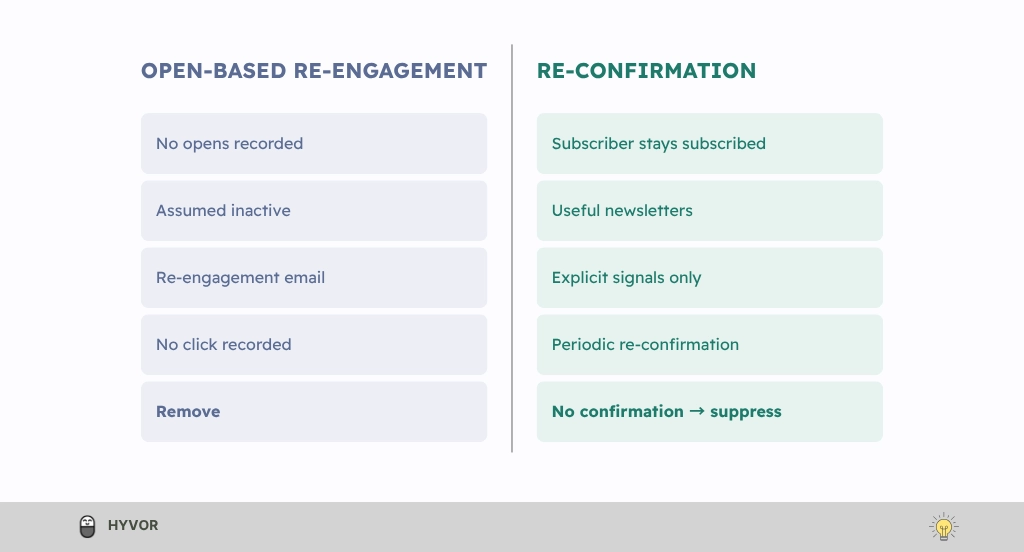
If your definition of inactive is “hasn’t opened in six months,” you can’t use that definition without open tracking. And even if you could, an open was always just a proxy.
Use signals you can actually observe
Some cleanup happens automatically.
Hard bounces indicate that an address is permanently undeliverable and should generally be removed or suppressed.
Repeated soft bounces can indicate a mailbox that is consistently unavailable.
Spam complaints are an explicit signal that the recipient doesn’t want the messages.
Unsubscribes are even clearer: the subscriber has told you to stop.
Voluntary replies can also be useful. “I don’t really read these anymore” is a much stronger signal than an inferred inactivity score.
These signals can keep your list healthy without needing to know who opened what. But they don’t solve one problem: what about the person with a perfectly valid email address who simply stopped caring?
That’s where re-confirmation comes in.
Use re-confirmation instead of open-based re-engagement
Instead of sending “click here if you still want this newsletter,” which normally relies on a per-recipient tracked link, put the question to the subscriber directly.
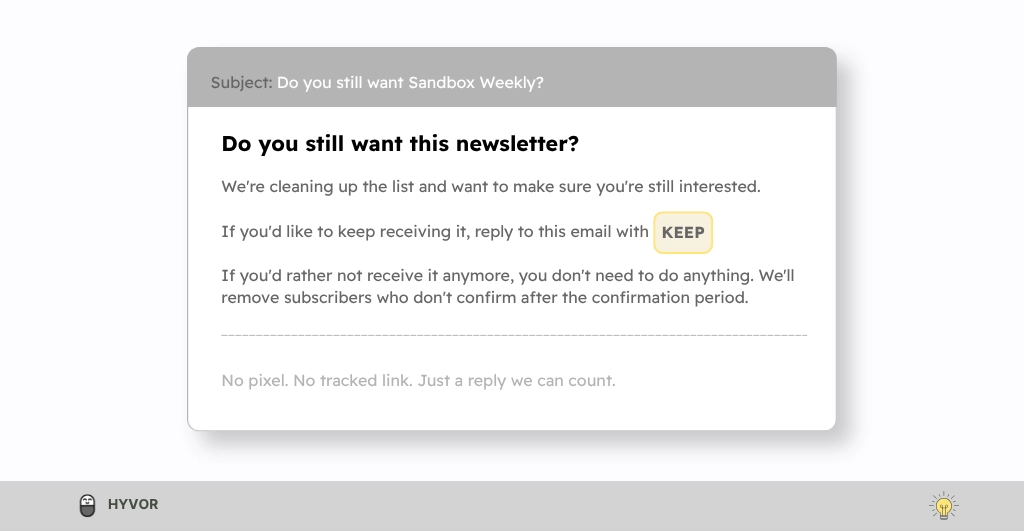
A reply is explicit. It needs no open pixel and no tracked click, and you can count it from your inbox. A confirmation page where the reader enters their email address works too. What matters is that the subscriber actively confirms the relationship.
What you can honestly claim about who you remove
Claiming you've identified “inactive subscribers” when you haven't is a step too far. Base cleanup on signals you actually have: subscription age, last confirmed preference, explicit replies, bounces, complaints, unsubscribes, and response to a re-confirmation campaign.
A policy like “subscribers on the list more than 12 months who don’t respond to a periodic re-confirmation request may be removed” is more honest than “subscribers who haven’t opened in 12 months will be removed.”
The tradeoff is simple. Without behavioral tracking, list cleaning is less precise. You can’t know everything a silent reader does. But you also can’t mistake an automated image request for genuine reading. You’re choosing between inferred engagement and explicit engagement.
Consider a softer form of cleanup
Removal doesn’t have to be the first option. Depending on your newsletter, you could offer:
a lower-frequency digest,
a temporary pause,
a preference center,
topic selection,
or an option to receive fewer emails.
For example: “Weekly is too much? Switch to our monthly digest.” This gives subscribers a way to adjust the relationship themselves. In many cases, that’s better than forcing the choice between “receive everything” and “leave.”
What “tracking-free” actually means
It’s worth being precise here. “Tracking-free” does not mean “we collect no data.” You may still have:
Operational data | Delivery records, bounces, unsubscribes, complaints. |
Website data | Server logs, IP addresses, aggregate analytics, conversion data. |
What you are avoiding is the creation of unnecessary subscriber-level behavioral data.
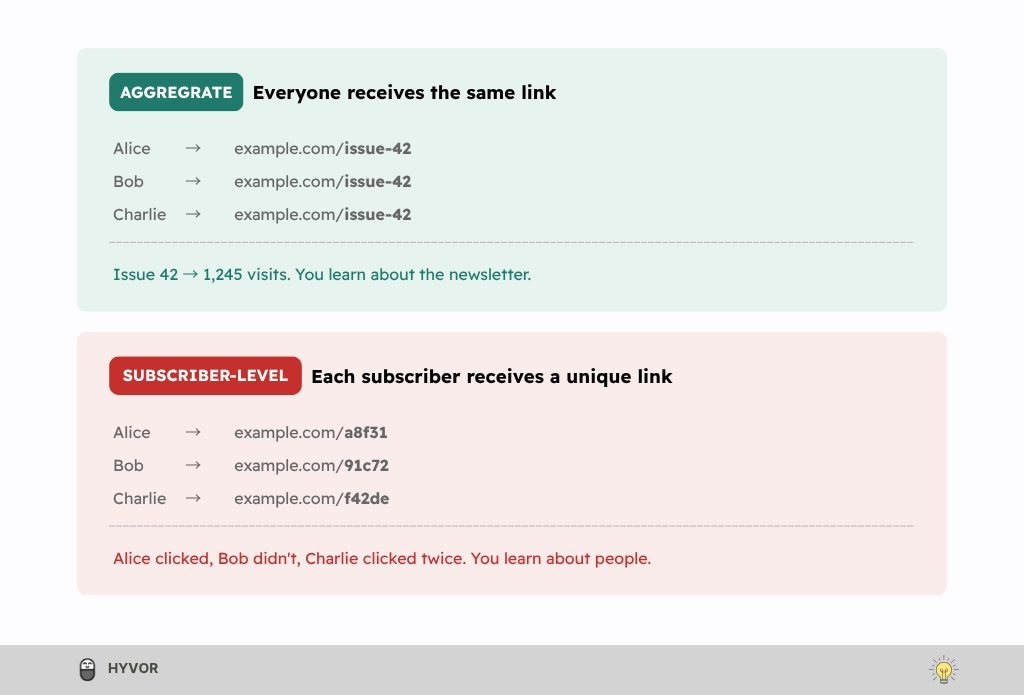
A useful question is:
Can this signal be connected back to one particular subscriber?
If yes, you're moving toward subscriber-level tracking. If no, you're measuring the audience or the outcome at an aggregate level.
A practical tracking-free newsletter workflow
Now put everything together.
Before sending | Decide what the issue is trying to accomplish. |
After sending | Check delivery health: bounces, complaints, deliverability signals. |
Every few months | Review subscriber growth, unsubscribes, complaints, replies, recurring questions, survey responses, and business outcomes. |
Periodically | Run a survey. |
That’s your analytics and list-maintenance process.
An example: Sandbox Weekly
Imagine a newsletter with around 3,000 subscribers and no open or click tracking. After one issue, the publisher sees this:
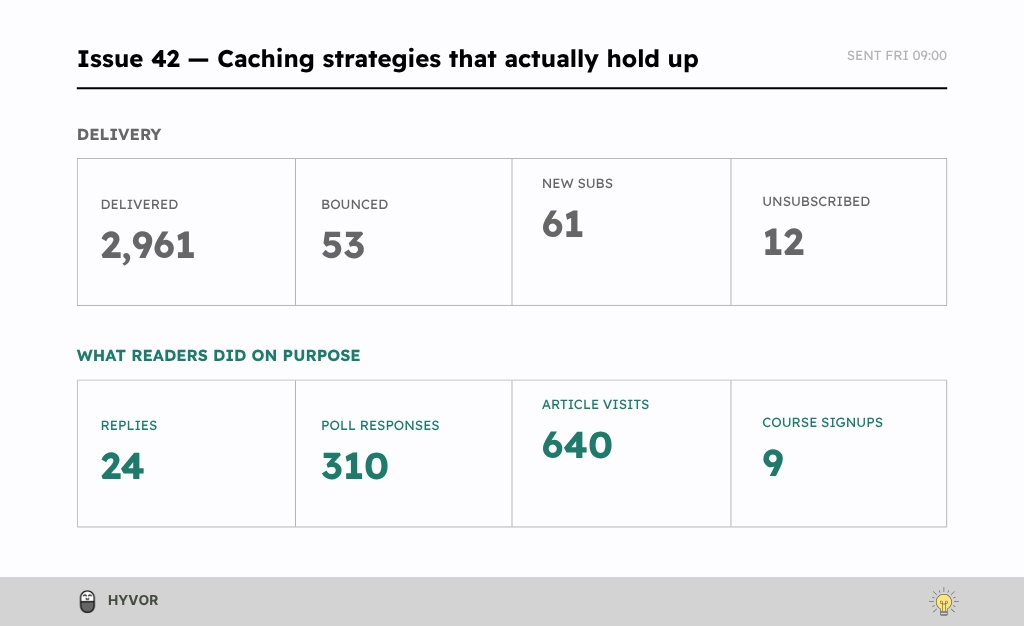
Four readers independently reply with the same message:
“The caching explanation was useful, but I still don’t understand invalidation.”
So the next issue starts with: Several readers asked about cache invalidation after last week’s issue. Let’s go deeper.
The publisher didn’t need to know whether those four people opened the previous email. They told them.
Six months later, the publisher reviews the list and finds an old cohort from a conference giveaway. The addresses are still deliverable, but there’s no reliable way to know whether those people are reading. Instead of pretending otherwise, they send a re-confirmation message. Some reply. Others don’t. The unconfirmed addresses are removed according to the stated policy.
The list is smaller, but nobody pretended an invisible pixel proved who was reading.
Common concerns
“Won’t I just be sending emails into a void?” Only if you design it that way. A newsletter with a noreply@ address, no questions, and no outcome measurement can absolutely feel like a void. But open tracking doesn’t solve that either. A pixel tells you an image was requested. It can’t tell you someone found your explanation useful. The absence of tracking doesn’t create the void. The absence of feedback channels does.
“How do I know which topics people like?” From replies, reader questions, polls, surveys, aggregate article traffic, referrals, and recurring requests. What you won’t know is which specific subscriber liked which topic, and for most newsletters that’s fine. Someone clicking a link doesn’t tell you why. Someone writing “please write more about PostgreSQL performance” does.
“What if nobody replies?” Sometimes nobody will, and that doesn’t automatically mean failure. Maybe the question was vague, the invitation easy to miss, or readers found the issue useful but had nothing to add. Turning reply count into another engagement score backfires quickly, controversial content produces more responses than useful content. Use several signals together and give your audience time.
What you actually give up
It’s worth being honest. Running a newsletter without open and click tracking isn’t free.
Open-based A/B testing | You can’t reliably compare subject lines using open rates. You’ll need to evaluate them using downstream outcomes, or rely more on editorial judgment. |
Behavioral segmentation | You can’t automatically create “people who clicked three articles about React.” Instead, readers can tell you what they're interested in, or choose their own preferences. |
Individual lead scoring | If your sales process depends on scoring every subscriber by email behavior, a tracking-free newsletter may not fit that business model. |
That’s okay.
The goal isn’t to pretend every newsletter has the same requirements. It comes down to one question:
What information do I actually need to run this newsletter well?
You may discover that you need much less than your dashboard suggests.
A simple measurement framework
Question | Signal |
Is the email reaching people? | Delivery and bounce data |
Is the audience growing? | Net subscriber growth |
Is anyone unhappy? | Unsubscribes and complaints |
Is the content useful? | Replies and surveys |
What should I write next? | Reader questions |
What do readers want more of? | Polls and surveys |
Is the list healthy? | Bounces, complaints, re-confirmation |
Did the newsletter achieve its goal? | Aggregate conversions |
That’s enough to run a surprisingly effective newsletter. You don’t need to know everything each subscriber did. You need to know enough to make the next issue better.
Replace surveillance with conversation
Go back to the question at the beginning: if you can’t see who opened or clicked, how do you know anybody cares?
You invite them to tell you. You give them an easy way to reply. You listen to what they say. You watch the outcomes that matter. And periodically, you check who's still there.
Running a newsletter without opens and clicks doesn’t mean giving up on feedback, measurement, or a healthy list. It means changing where all three come from: from inferred behavior to explicit signals.
You lose two numbers. You gain a conversation.

Comments