How to Write a Comment Policy: Community Guidelines with Template
A comment policy tells readers what they can post under your articles and what happens when they break the rules. It's the page you wish you had the first time a thread turns personal, link spam piles up, or a commenter asks why their comment vanished.
You can write yours before any of that happens. This guide walks through what a comment policy should cover, how to write rules people can actually follow, and how to enforce them without looking arbitrary.
If you just want the text, skip to the comment policy template. It's free to copy and edit.
What Is a Comment Policy?
A comment policy is a public set of guidelines for your comment section: who can comment, what's allowed, what gets removed, and how decisions can be challenged. It speaks to commenters, so it should read like a note from the site owner, not a contract.
It often gets confused with two other documents.
Document | Who it's for | What it covers |
|---|---|---|
Comment policy | People who comment on your posts | Conduct rules, moderation, consequences, appeals |
Community guidelines | Members of a larger community (forum, social channels, comments) | The same ideas, applied across every place people post |
Terms of service | Every visitor and user | Legal terms: liability, ownership, accounts, disputes |
For a blog, "comment policy" and "community guidelines" usually mean the same page. Pick whichever name fits your site and link it from your terms of service.
Why Your Comment Section Needs One
Comment sections affect how readers see the whole site, not only the people who post. In a 2019 study by the Center for Media Engagement, participants who saw mostly uncivil comment threads rated the news site itself more negatively. Opening the thread with a few civil comments didn't fix it.
A written policy won't stop incivility on its own. What it gives you is a written rule to point to when you remove something, which is easier to defend than a judgment call made in the moment.
What Should a Comment Policy Include?
A complete comment policy answers seven questions. Skip one, and you'll end up answering it in a heated reply thread instead. The template later in this guide has ten headings, because it splits two of these into two headings each and adds a short note on your data.
Part | The question it answers | Example line |
|---|---|---|
Purpose and scope | Why comments exist here, and who can post | "Comments are for discussing the post. You need an account to comment." |
What's welcome | What kind of discussion you want | "Disagree with us all you like. Bring reasons." |
What's not allowed | The specific behavior you remove | "No personal attacks, slurs, or threats." |
Links and promotion | When links and self-promotion are fine | "Links that support your point are fine. Ads are not." |
Moderation | Who reviews comments, and when | "New commenters are held for review." |
Consequences | What happens after a violation | "Repeated violations lead to a ban." |
Reporting and appeals | How readers flag comments and challenge decisions | "Email us if you think we got it wrong." |
The last row is the one most policies leave out. In a study presented at CHI 2024, researchers reviewed the content moderation policies of 43 platforms; only 17 had complete policies, by their definition, and none of the four traditional news sites in the sample did. Appeals were the weak spot: 75.3% of the appeal-related text they found was about copyright, against 9.4% about harmful speech.
How to Write a Comment Policy in 7 Steps
The steps follow the order of the finished page, so you can write as you go and end up with a draft.
Step 1: Define the Purpose and Who Can Comment
Start with one or two sentences on why your comment section exists. "Comments are for discussing the article and adding what we missed" does more work than it looks: every later rule can point back to it.
Then decide who can comment, because this choice shapes the rest of the policy.
Account holders only. You can warn, ban, or trust a specific person, and your rules can talk about consequences for "your account".
Guests allowed. More people comment, but there's no account to ban, so repeat offenders are harder to stop.
Anonymous names allowed. Worth saying plainly if you allow pseudonyms, so nobody gets accused of hiding.
Write down what you chose. Readers shouldn't have to find out by trying.
Step 2: Say What's Welcome, and Allow Criticism
A policy that only lists bans reads like a warning sign. Say what good discussion looks like on your site first. The University at Buffalo's guidance for its moderators puts it in four words: "Debate, but don't attack."
This is also where you make clear that criticism of you is allowed. If readers suspect that disagreeing with the author gets them deleted, your rules about civility will look like cover. The UK's Equality and Human Rights Commission says in its community guidelines that critique of its work is welcome. Science-Based Medicine's comment policy makes the same promise about disagreeing with its editors.
The line to draw is between the argument and the person:
Criticism (keep it) | Abuse (remove it) |
|---|---|
"Your second point ignores the 2023 update." | "Only an idiot would write this." |
"I've used this tool for years and disagree." | "You're clearly paid to say this." |
"This post is one-sided." | "People like you shouldn't be allowed to write." |
Put one or two pairs like these in your policy. They show readers where the line sits better than an adjective like "respectful" can.
Step 3: Turn Your Values into Specific Rules
"Be respectful" is a value. A rule is something two moderators would apply the same way to the same comment.
That gap matters more than length. In a 2026 study in Policy & Internet, Quint and colleagues found that people interpreted platform guidelines inconsistently, especially longer ones. But when the researchers shortened Meta's guidelines, disagreement didn't go down. Their conclusion was that the results point toward clearer, example-driven guidance.
So rewrite each vague rule until it names behavior:
Vague | Specific |
|---|---|
Be respectful. | No insults, name-calling, or slurs aimed at other commenters or the author. |
No spam. | No ads, affiliate links, or the same comment posted on several articles. |
Stay on topic. | Comments should relate to the article. Off-topic questions can go to [contact page]. |
No trolling. | Don't post things only to provoke a reaction, such as repeating a point after a moderator has asked you to stop. |
Keep it clean. | No sexual content or graphic violence. Mild swearing is fine. Swearing at someone isn't. |
The last row is a judgment call you have to make for your own site. Some blogs allow swearing, some don't. The rule just has to say which.
Links and self-promotion. Decide whether links are allowed at all, and when. A common middle ground is to allow links that support a point and remove links that exist to advertise. Nature's community guidelines ban using comments to sell or promote. If you allow links, Google's documentation recommends marking links in user-generated content with rel="ugc", and its page on preventing user-generated spam lists a clear abuse policy among the defenses, alongside moderation and blocklists.
Hyvor Talk adds rel="ugc" to links in comments, so you don't have to add it yourself.
Privacy and copyright. Two short lines cover most of it: don't post other people's personal information (addresses, phone numbers, private messages), and don't paste whole articles or images you don't have the right to share. Quoting a few lines to make a point is fine. Your privacy policy, not your comment policy, should explain what data you collect from commenters.
AI-generated comments (optional). If you've started seeing comments that read like generic summaries of your post, you can add a rule for them. Keep it about behavior you can see, such as "comments that don't engage with the post, whoever or whatever wrote them, may be removed", since you can't reliably prove a comment was machine-written.
Step 4: Choose a Moderation Model and Describe It Honestly
There are three common ways to handle new comments:
Model | How it works | Trade-off |
|---|---|---|
Pre-moderation | Every comment waits for approval before it appears | Little abuse gets through, but conversations slow down |
Post-moderation | Comments appear at once; you remove problems after | Fast, but bad comments are visible until you find them |
Hybrid | Most comments appear at once; some are held by rules, filters or a reader's flag | More setup, but you spend review time where it's needed |
Real policies show all three. The UK government's Public Policy Design blog pre-moderates every comment. The Foreign, Commonwealth and Development Office says on its commenting guidelines that comments are reviewed usually within one working day. Science-Based Medicine holds comments from new commenters for 36 hours. A 2012 guide from the Center for Digital Ethics & Policy notes the cost of the first approach: pre-moderation slows the conversation down.
Whichever model you pick, describe only what you actually do. If you hold first-time commenters, say so, or people will think they were censored. If moderators sometimes edit comments (to remove a phone number, for example) instead of deleting them, say that too.
Step 5: Set Consequences That Match the Violation
Not every broken rule deserves a ban. A single off-topic comment and a threat against another reader shouldn't get the same response. Spell out the steps so commenters know what comes next and moderators handle similar cases the same way.
Violation | Example | Typical first response |
|---|---|---|
Minor | Off-topic comment, one promotional link | Remove the comment, or reply with a reminder |
Repeated minor | The same promotional link on several posts | Warning, then a temporary block |
Serious | Personal attack, slur, doxxing | Remove at once; ban if it happens again |
Severe | Threats of violence, illegal content | Remove, ban immediately, report where required |
This is a framework, not a standard, so change the rows to fit your site. Published policies vary a lot here. Science-Based Medicine gives roughly three strikes for minor offenses. The University at Buffalo lists a range of actions for its moderators: respond, warn, delete, block and report. The Center for Digital Ethics & Policy guide adds editing a comment and deleting it with a note explaining why.
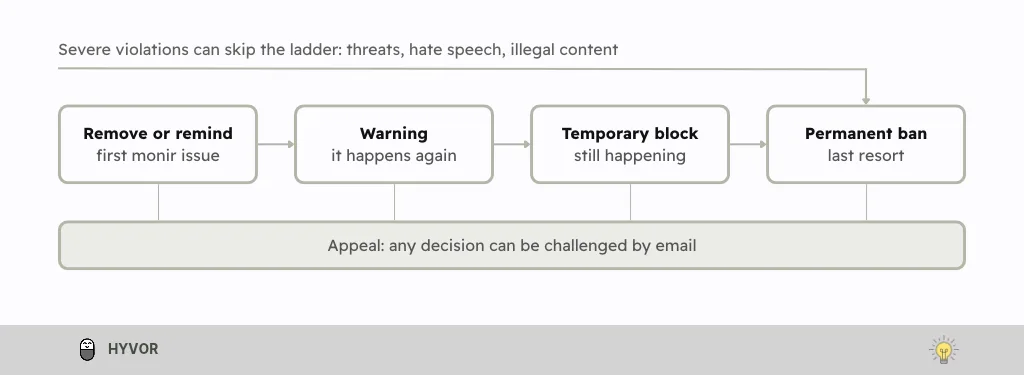
Most violations climb the ladder one step at a time. The worst ones can go straight to a ban. The appeal bar is a recommendation: offer it at every step if you can, and say plainly what you do offer.
Step 6: Explain Removals and Offer an Appeal
Tell readers how to report a comment and how to challenge a decision about their own. Both can be one sentence each.
Explaining removals is worth the extra minute. The Center for Digital Ethics & Policy guide suggests deleting a comment with a note that explains why, and the EU's Digital Services Act asks hosting services to give reasons when they remove content (see Legal and Privacy Considerations).
A short note is enough: which rule the comment broke, and where to write if they disagree.
Hyvor Talk labels a signed-in commenter's own comment as deleted, spam or pending, but the label doesn't say why.
For appeals, keep it simple and give a time frame you can keep. The EHRC promises to respond to complaints about its moderation within five working days. If you want a benchmark, the Santa Clara Principles, a standard written by civil-society groups including the EFF and the ACLU, say appeals should be reviewed by someone who wasn't involved in the original decision. On a one-person blog that isn't possible, and that's fine to admit. You can still promise to look again with fresh eyes.
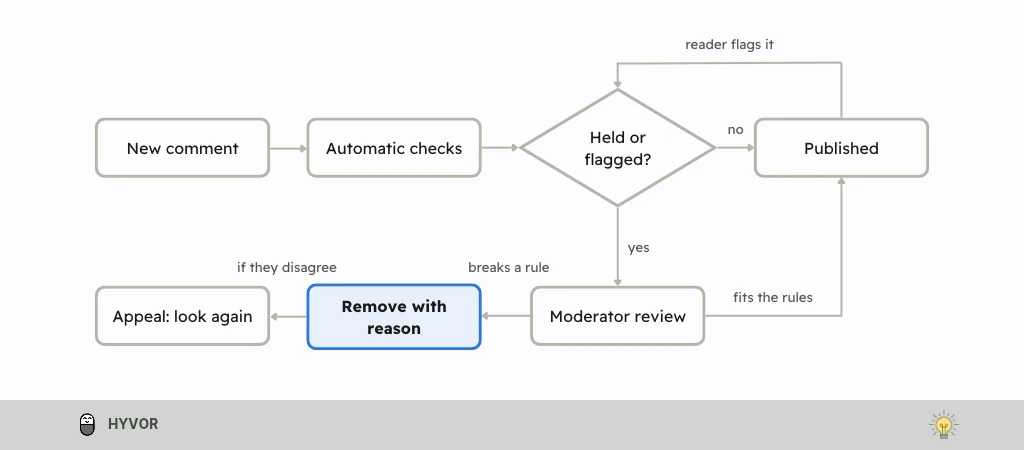
Comments that pass the automatic checks go live. Held or flagged ones get a human review first.
Step 7: Publish It Next to the Comment Form
A policy linked only from your footer is easy to miss. Put a short link to it where people write comments.
Hyvor Talk has a note setting that shows text just under the comment box, which is a good place for a link to your policy. Write the note as an HTML link, because plain URLs and Markdown links don't become clickable there.
<a href="https://yoursite.com/comment-policy">Read our comment policy</a>
Two more habits keep the policy credible:
Date it. Add "Last updated: [date]" at the bottom, so returning readers can tell when rules changed.
Review it. Read it again when you notice the same argument with commenters more than once. That usually means a rule is missing or unclear.
Comment Policy Template: Copy, Customize, and Publish
Copy the template below and replace everything in square brackets. If the default wording in a section doesn't fit your site, swap in one of the alternatives after the template. Delete any section that doesn't apply to your site. Keep only the promises you can keep, such as a reply time you can actually meet.
Full Comment Policy Template
Comment Policy for [Site Name]
Last updated: [Month Day, Year]
Why we have comments
Comments are here so readers can discuss our posts, add what we missed and ask questions. We read them, and we want them to stay useful for the next person who scrolls down. This policy applies to all comments and replies on this site.
Who can comment
You can comment as a guest with a name and email address.
What we welcome
Disagreement is welcome, including disagreement with us. If you think a post is wrong, say so and explain why. Personal experience, corrections and sources are especially helpful.
What we remove
We remove comments that:
- Insult, threaten or harass another commenter, the author or anyone else
- Use slurs or attack people for who they are, such as their race, religion, gender, sexuality or disability
- Share someone's personal information, such as an address, phone number or private messages
- Advertise products or services, or include links that exist only to promote something
- Repeat the same comment across several posts
- Contain sexual content, graphic violence or anything illegal
- Copy large parts of someone else's work without permission
Criticizing an idea is fine. Attacking a person is not. "This argument ignores the cost" stays. "You're an idiot" goes.
Links
Links are welcome if they support your point.
How moderation works
Comments from first-time commenters are held for review, usually within [time frame]. Other comments appear right away, and we review flagged comments as soon as we can.
We may remove or hold comments that break these rules.
What happens if you break the rules
- A first minor issue usually gets the comment removed, sometimes with a reminder.
- Repeated issues lead to a warning, then a temporary block, and then a ban if they continue.
- Serious violations, such as threats, hate speech and illegal content, may lead to an immediate ban.
We look at each case in context, so the action we take depends on how serious the behavior is and how often it happens.
Reporting a comment
If you see a comment that breaks these rules, email us at [email address]. We review every report.
If you think we got it wrong
Email [email address] with a link to the post and what you wrote, if you have it. We'll take a second look and reply within [number] working days.
Your data
When you comment, we collect [the data you collect]. See our Privacy Policy for details.
Thanks for keeping the comments worth reading.
Alternative Wording and Optional Lines
Use these if the default wording in the template doesn't match your site. The bold label names the section each line replaces or joins.
Who can comment, account required: You need an account on [Site Name] to comment.
Who can comment, any name: You can comment under any name, but please use the same one each time.
Links, held for review: Comments with links are held for review before they appear.
Links, not allowed: We don't allow links in comments.
Reporting a comment, with a report button: If you see a comment that breaks these rules, use the report button on the comment. We review every report.
What we remove, for generic comments (add as a bullet): Ignore the post entirely, such as generic text that could sit under any article
How moderation works, if you edit comments (add after the first paragraph): We only edit comments to remove personal information or a broken link, and we mark the comment as edited.
Short Version for Small Blogs
If you moderate alone and get a handful of comments a week, this is enough:
Comment Policy
Comments are for discussing the post. Disagree as much as you like, but keep it about ideas, not people. I remove insults, harassment, spam, ads and anyone's personal information. Comments with links may wait for approval. Repeat offenders get banned. If you think I removed something unfairly, email [email address] and I'll take another look.
Last updated: [date]
Before You Publish It
Start by filling in every bracket, including the site name and dates. Then read the template once more with your own site open next to it. The default lines under "Who can comment" and "Links" are only a guess at what your site does, so swap in an alternative if they're wrong. "How moderation works" should describe the settings you actually use, and if you edit comments, add the editing line from the alternatives.
Three smaller things:
Pick an appeal reply time you can keep, even in a busy week.
Link your privacy policy, and check that it mentions comment data.
Link this policy from your comment form.
When it's done, ask one other person to read it and tell you what's unclear.
Examples of Good Comment Policies
Reading a few real policies is the fastest way to see which choices you agree with. These five take noticeably different approaches.
Policy | Approach | Worth borrowing |
|---|---|---|
Every comment is pre-moderated | It tells readers how soon the team aims to reply: within two working days | |
Comments are reviewed by moderators | It gives a review time (usually one working day) and says comments posted more than four weeks after a post may not be published | |
Open debate on research | It welcomes opinions but asks for evidence, and bans selling or promotion | |
Hybrid: certain keywords trigger review | It welcomes critique of its own work, separates criticism from attacks, and commits to answering moderation complaints within five working days | |
Strict, with detailed rules | It explicitly allows disagreement with its editors, holds new commenters for 36 hours, and openly says it uses shadow bans |
Three things to keep in mind. The EHRC guidelines cover its social media channels rather than website comments, though the approach carries over well. Nature's community guidelines cover its websites and social media pages, including comments, posts and replies, so they're broader than a blog comment policy, though the rules on evidence and promotion carry over. And Science-Based Medicine's appeals are narrow, which suits a site that gets heated debates about medicine but would feel heavy on a cooking blog.
The Science-Based Medicine example raises a question worth settling for your own site: if you use shadow bans (where a user's comments stay visible only to them), will you say so? Disclosing it may make shadow bans less effective, but it means nobody can accuse you of hiding the practice.
How to Enforce Your Comment Policy Consistently
A comment policy only works if the same comment gets the same response on a Monday and a Friday. Two things help: automation for the obvious cases, and records for the rest.
Use Automation, but Keep Human Review
Most commenting systems let you turn the clear parts of your policy into settings. Here's how the policy maps onto Hyvor Talk, our commenting platform, based on our documentation:
Policy rule | Hyvor Talk feature |
|---|---|
"Comments with links are held for review" | |
"No promotion from these sites" | A rule that flags or removes links to listed domains |
"No slurs" | A word-list rule that holds or removes matching comments |
"Readers can report comments" | Reader flags for moderators to review, which can also trigger a rule |
"New or untrusted comments are held" | Pre-moderation, per page or for the whole site |
"Spam is removed" | |
"Repeat offenders are banned; regulars skip review" | Banning users, hiding their comments without telling them, or marking users as trusted so their comments skip review |
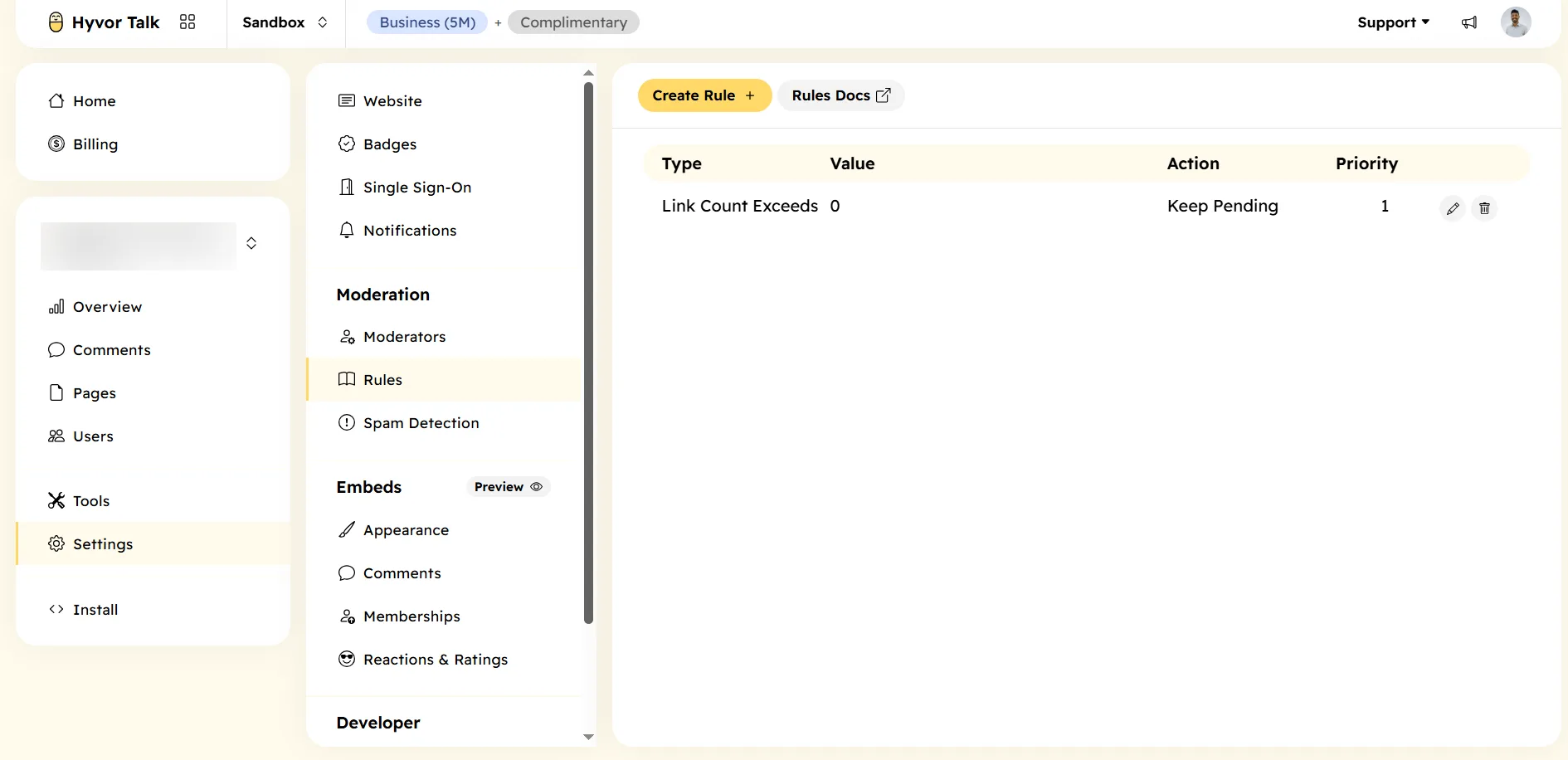
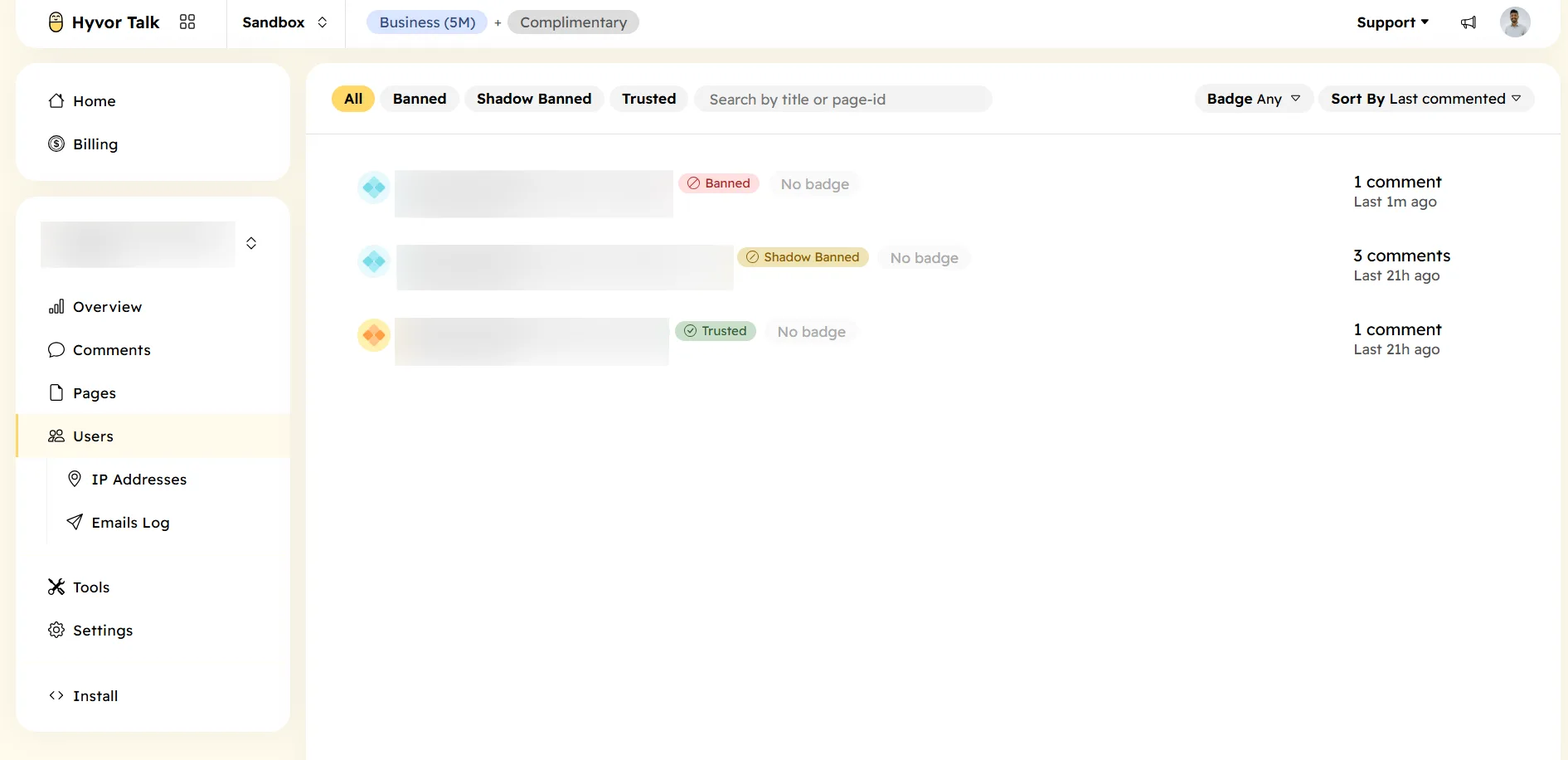
Automation catches the clear cases. Gray areas, like sarcasm, in-jokes or a heated reply to a heated comment, still need a person. In interviews with 18 comment moderators, Wiesner, Schäfer and Lecheler found that moderators deleted clear violations, sometimes automatically, but handled gray areas by engaging with commenters. The moderators also saw current tools as unable to handle comments that depend on context.
It also helps to show up. In a 2014 study from the Center for Media Engagement run on a local TV station's Facebook page, uncivil comments were about 17% less likely when a recognizable reporter took part in the discussion. The authors say that it reduced incivility but didn't cure it.
Keep Records and Train Moderators
If more than one person moderates, write down how you've handled past cases and share it. A short list like "we remove X, we leave Y" stops the policy from drifting.
Keep a record of serious cases, too. The University at Buffalo's guidance recommends keeping screenshots of problem comments. In Hyvor Talk, rule matches are logged next to each comment in the Console, and moderators can add private notes to a user, which helps when someone appeals.
Legal and Privacy Considerations
In many places, a comment policy is a house rule rather than a legal requirement. The table below is a starting point for where to look, not legal advice. If your site is large, commercial or in a regulated field, check with a lawyer.
Region | Law | What it means for blog comments |
|---|---|---|
EU | Article 14 asks intermediary services to describe their moderation policies and tools in plain language in their terms, and Article 17 asks hosting services to give reasons when they remove content. Recital 13 says a newspaper's comment section could count as a minor feature of the main service, which would keep it out of the stricter rules for online platforms. Article 19 also exempts micro and small platforms from the complaint-handling duty in Article 20. Whether these apply to your site depends on how it's set up. | |
UK | Services where users can only post comments or reviews about the provider's own content are exempt, which is likely to cover a typical blog comment section. | |
US | Site owners generally aren't treated as the publisher of comments other people post, and good-faith moderation is protected. Exceptions include federal criminal law and intellectual property. |
Even where no law requires it, the habits the DSA asks for (a plain description of your moderation and a reason when you remove something) are worth following either way.
For privacy, keep the comment policy short and link to your privacy policy. That's where readers should learn what you collect when they comment, such as names, email addresses or IP addresses, and which third-party services see that data. If you use a spam filter that sends comments to an outside service, your privacy policy should say so.
FAQ
What is comment moderation?
Comment moderation is the work of checking comments against your rules and deciding what happens to each one: publish it, hold it for review, edit it, remove it, or act on the commenter. Sites usually pick one of three models, which Step 4 compares: review every comment first, remove problems after they appear, or a mix of the two.
Do I need a comment policy for a small blog?
If you allow comments, a short one helps. It gives you something to point to the first time you remove a comment. The short version of the template is written for small blogs.
How do I ban someone from commenting?
Write the steps into your policy first (Step 5), then use your commenting system's ban tools. In Hyvor Talk, you can ban a registered user directly, while guests can only be blocked by IP address. A ban applies only to your own site.
How do I restrict comments on a post?
There are two common options: close the post to new comments, or hold every new comment for review. Hyvor Talk offers both for individual posts, and readers of a closed post see a notice that comments are closed.
Can I delete comments that disagree with me?
A site owner can generally set and enforce rules for their own comment section, but whether you can remove a comment is a different question from whether you should. If readers see criticism disappearing, they'll stop trusting the rest of your moderation, so remove comments for breaking a published rule, such as abuse, threats or spam, not for disagreeing. Several published policies, including the EHRC's and Science-Based Medicine's, explicitly protect disagreement. The legal position depends on where you and your readers are. In the US, Section 230 protects good-faith moderation, but it has exceptions, such as federal criminal law and intellectual property.
Where should I put my comment policy?
On its own page, linked from just above or below your comment form, and from your footer or terms of service.
Should I allow anonymous comments?
It's a trade-off. Anonymous or guest comments lower the barrier to joining in, but they're harder to moderate, because there's no account to warn or ban. Whatever you choose, state it in your policy.
Conclusion
A good comment policy is short, specific and honest about how you moderate. Start with why comments exist on your site, allow criticism, write rules that name behavior, and say what happens when someone breaks them. Then link to it from your comment form.
The template covers all of that. Copy it, cut what doesn't fit, and set up your commenting system so the easy cases handle themselves. If you're choosing a commenting system, Hyvor Talk includes the rules, spam detection and user controls described above.
