Content Localization: A Practical Guide to Strategy and Execution
Imagine a US-based hiking retailer expanding into France. It translates a top-performing article, "The Best 10-Mile Day Hikes in Acadia National Park," into French word for word. While the text is grammatically correct, it fails to resonate: French readers measure distance in kilometers, expect local trail recommendations in the Alps or Pyrenees, and search using localized terms like randonnée à la journée.
Localization is the strategic adaptation of content to meet the linguistic, cultural, functional, and technical expectations of a specific target market. While translation converts text from one language to another, content localization ensures the entire page feels naturally designed for the local audience. Whether you are using an open-source CMS or a traditional content management system, this guide will cover strategic planning, practical examples, publishing implementation, and performance measurement.
What Is Content Localization?
Content localization is the process of adapting digital material, including text, images, formats, and design, for a specific geographic or cultural market so that it feels natively created for that audience.
Beyond linguistic accuracy, effective localization considers regional preferences, regulatory guidelines, measurement systems, currencies, and local search intent.
Approach | What changes | Example |
Translation | Language | Rewriting an English guide in French |
Localization | Language and market-specific details | Updating the guide's measurements, examples, and links for France |
Transcreation | Creative message or presentation | Rewriting a campaign headline to suit a local audience |
Internationalization | Technical support for locales | Allowing a website to display different scripts and regional formats |
Why Is Content Localization Important?
Publishing tailored content directly impacts audience engagement, brand perception, and international growth.
Increases organic search visibility: Captures local search queries and long-tail terms unique to target regions.
Improves user engagement: Reduces bounce rates by presenting relevant local examples and clear messaging.
Builds consumer trust: Demonstrates commitment to regional audiences through familiar cultural contexts.
Higher conversion rates: Eliminates purchase friction by localizing pricing, currencies, and checkout terms.
Strengthens brand reputation: Prevents cultural misunderstandings or inappropriate messaging in new markets.
Maximizes content ROI: Extends the lifecycle of proven editorial assets across new revenue channels.
Outperforms machine translation: Provides meaningful user experiences that generic automated tools cannot match alone.
What Types of Content Should You Localize?
Different digital assets require varying degrees of adaptation depending on their intent, complexity, and audience interaction.
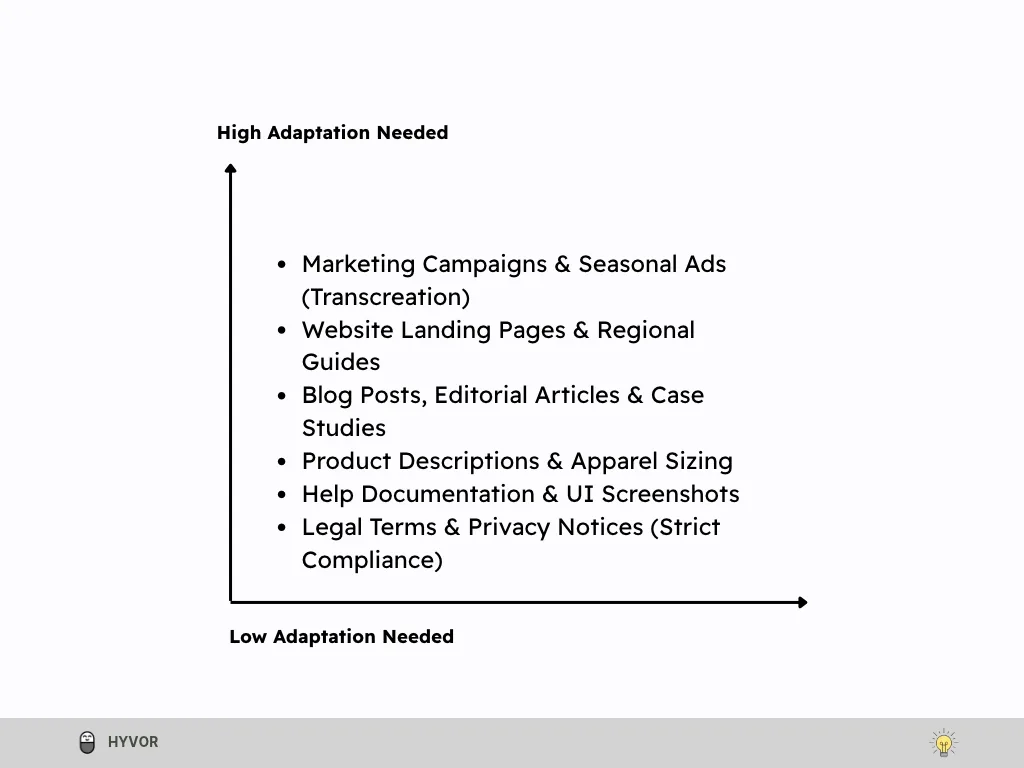
Content type | What may need localization | Example |
Blog posts and articles | Terminology, examples, measurements, external links | Regional buying guides |
Website landing pages | Value proposition, CTAs, pricing details | Country-specific product pages |
Product descriptions | Product availability, sizes, instructions | Apparel descriptions |
Help and technical content | Interface terms, screenshots, product instructions | Software setup guides |
Marketing campaigns | Headlines, references, visuals | Seasonal promotions |
Video and audio | Captions, subtitles, spoken content | Local-language tutorials |
Legal information | Jurisdiction-specific statements and requirements | Privacy notices |
How Do You Decide What Content to Localize First?
Selecting content for localization starts with the target audience rather than the volume of available materials. A site containing 500 English articles may only have 30 pieces that fulfill a strategic business need in its target expansion market. Prioritizing high-performing assets with broad market demand prevents wasted localization resources.
Identify the Market and Its Content Needs
Evaluate organic search demand, existing site traffic, and customer support queries originating from target countries. Focus efforts on regions where product-market fit is established and localized content will immediately clear acquisition bottlenecks.
Prioritize Content Based on Value and Adaptation Effort
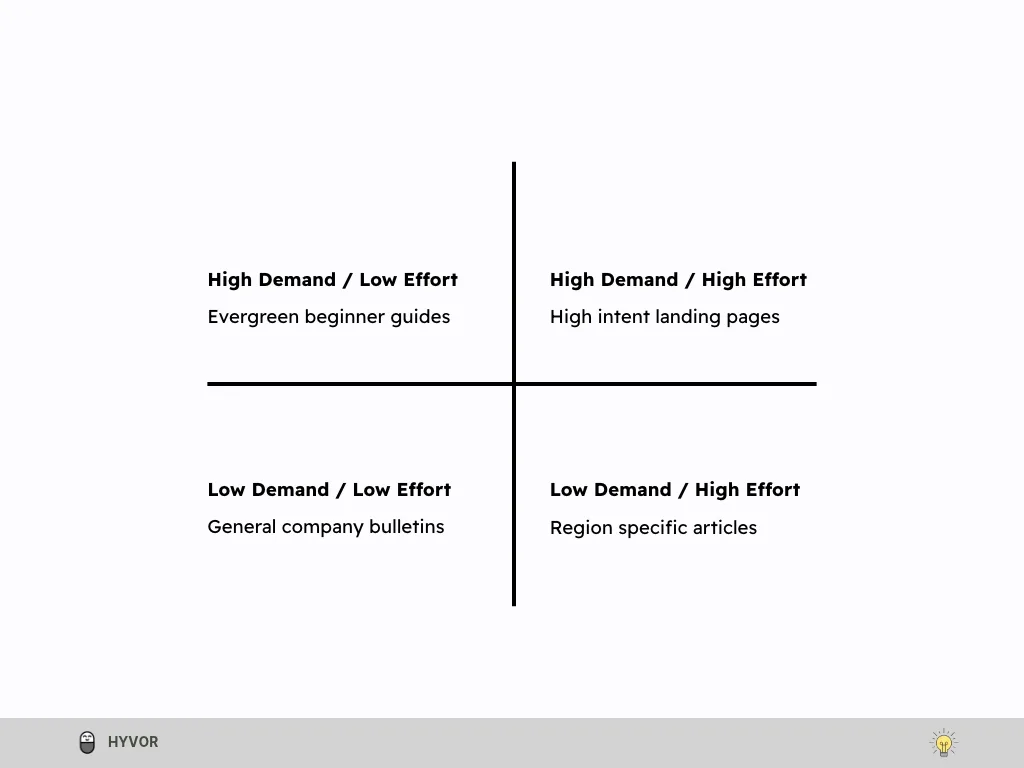
Content | Local demand | Adaptation effort | Suggested priority |
Evergreen beginner's guide | High | Low | High |
High-intent product landing page | High | Medium | High |
Region-specific article | Low | High | Low |
Outdated blog post | Low | Medium | Review or retire |
Important help documentation | High | Medium | High |
How Much of the Original Content Needs to Change?
Localization does not always demand a total rewrite. Depending on how well the source topic translates across borders, editorial teams can choose from four primary levels of adaptation:
Adaptation level | When it makes sense | Work involved |
Direct translation with review | Information applies equally across markets | Translate and verify meaning |
Translation with local edits | Most content applies, but certain details differ | Update formats, links, and examples |
Full content adaptation | Readers have different needs or search intent | Change structure and supporting information |
New local content | The original topic does not fit the target market | Research and write a new piece |
How to Build a Content Localization Strategy
Executing a structured localization strategy keeps editorial teams aligned and ensures quality across every published language version. Consider the following step-by-step workflow for an outdoor publisher adapting an article on rain jacket selection for the French market.
Step 1 - Choose the Target Language and Market
Define the regional market explicitly, taking care to follow W3C guidelines on choosing a language tag by assigning standard BCP 47 language and region identifiers (such as fr-FR for France vs. fr-CA for Canada), as distinct locales feature unique regulatory frameworks, terminology, and search habits.
Scenario: The publishing team selects France (fr-FR) as its target locale due to rising organic search traffic from French IP addresses seeking outdoor gear recommendations.
Step 2 - Audit Your Existing Content
Catalog candidate articles and assess whether the core concepts carry intrinsic value for the target market or require complete restructuring.
Scenario: The team audits the top-performing guide "How to Choose a Rain Jacket for Hiking" and determines that while the underlying advice on waterproof ratings holds globally, regional gear references and sizing systems require updates.
Step 3 - Prepare Content for Translation and Adaptation
Author source content clearly by following W3C internationalization quick tips to ensure source-writing clarity, eliminate colloquialisms, isolate text from hardcoded images, and maintain standard local date, time, and numeric formats.
Scenario: The editor strips US-specific idiomatic phrasing (e.g., "weathering a sudden Nor'easter") and isolates image files so diagrams can accept French labels during production.
Step 4 - Create a Localization Brief and Glossary
Supply translators and localized editors with clear brand style rules, audience personas, target keywords, and a locked glossary of key technical terms.
Scenario: The team compiles a brief specifying target keywords (e.g., veste imperméable randonnée), preferred translations for technical terms (e.g., Coutures étanchées for seam sealing), and tone guidelines for French readers.
Step 5 - Choose the Translation and Review Process
Combine professional human expertise, localization technology, or AI-assisted translation paired with mandatory native-speaker editorial reviews. Machine translation should never be published directly without human oversight to verify context and tone.
Scenario: A native French outdoor writer translates the draft using a CAT tool containing the approved glossary, followed by a peer review from a local content manager.
Step 6 - Plan Publishing and Ongoing Ownership
Assign clear operational ownership for publishing, internal link integration, QA checks, and scheduled updates when the original source page changes.
Scenario: The localization editor sets up an automated sync in the editorial workflow to flag the French version for re-review whenever the English source guide receives major updates.
How to Publish Localized Content With a CMS
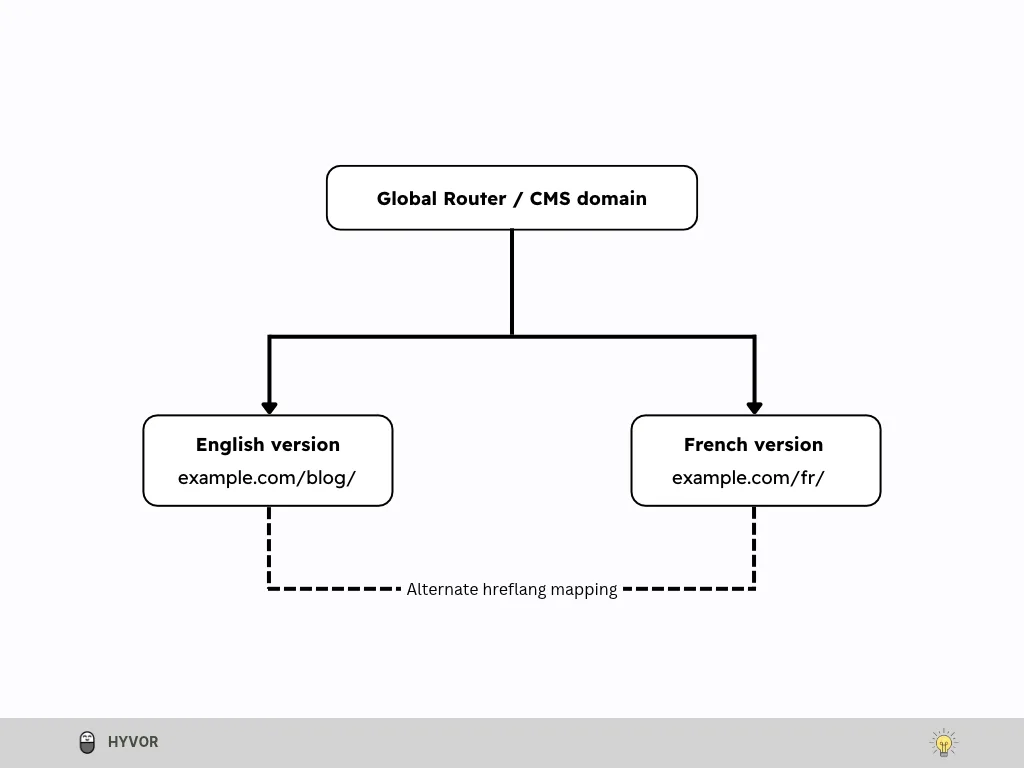
Connecting your editorial workflow to technical infrastructure ensures search engines index alternate language versions correctly while users navigate effortlessly between locales. Whether you publish via a traditional setup or a modern headless CMS, structured language management is essential.
Manage Language Versions of Each Article
A scalable multilingual CMS allows teams to create explicit multi-language pairings for every post, linking secondary variants directly to the original source asset.
Localize Website Navigation and Theme Text
Translate all global interface elements including headers, footers, search bars, category tags, author bios, and subscription forms, so visitors do not experience broken language transitions.
Configure Multilingual URLs and Search Signals
Following Google's search documentation on managing multilingual sites, websites should maintain separate, dedicated URLs for each language version (such as subdirectories /fr/ or dedicated ccTLDs) rather than relying on browser session cookies or dynamic IP redirects.
Additionally, implement hreflang annotations per Google's international SEO guidance to communicate alternate language and regional relationships directly to search engine crawlers.
<!-- Example hreflang annotations for English and French variants -->
<link rel="alternate" hreflang="en" href="https://example.com/blog/rain-jacket-guide" />
<link rel="alternate" hreflang="fr" href="https://example.com/fr/guide-veste-impermeable" />
<link rel="alternate" hreflang="x-default" href="https://example.com/blog/rain-jacket-guide" />
How to Measure Content Localization Success
Tracking performance across localized assets requires monitoring organic visibility, user interaction, and publishing efficiency metrics over time.
Metric | What it reveals | Where to measure |
Organic clicks by market | Whether localized pages attract search visitors | Google Search Console |
Localized keyword visibility | Whether content reaches relevant searches | SEO tracking tools |
Engagement | Whether readers interact with the content | Web analytics |
Conversion rate | Whether visitors complete the intended action | Analytics and conversion tracking |
Localization turnaround | Time between content approval and publication | Editorial workflow |
Update backlog | Number of translations awaiting review | Content management records |
Performance Example: If a localized French guide attracts a 40% increase in regional organic clicks, the publishing team should verify through Google Search Console whether traffic stems from relevant transactional terms (e.g., acheter veste randonnée). Furthermore, evaluate whether engagement aligns with core business goals, such as newsletter sign-ups or localized product purchases.
How Hyvor Blogs Supports Multilingual Publishing
Hyvor Blogs serves as an intuitive multilingual CMS designed for modern content operations, enabling teams to build and scale multi-language sites effortlessly without complex plugin architectures. For detailed platform setup, consult the official guide to multilingual blogging.
The platform provides native language variants for all posts, covering localized titles, custom URL slugs, content bodies, and meta descriptions. Content creators can translate tags, author profiles, and custom navigation menus into secondary languages, hosting localized pages under clean URL structures (e.g., /fr/bonjour-monde). The platform natively supports both left-to-right (LTR) and right-to-left (RTL) writing directions for global publishing requirements.
# Hyvor Blogs YAML Theme Localization Example (locales/fr.yaml)
search: "Rechercher..."
read_more: "Lire la suite"
newsletter:
title: "S'abonner à notre newsletter"
button: "S'inscrire"
Official Hyvor Blogs themes utilize simple YAML language files to render localized theme text automatically. Additionally, the system generates proper HTML lang attributes and automated hreflang XML sitemap tags for all alternate language versions. Discover how to configure localized publishing environments by exploring the Hyvor Blogs multilingual blogging documentation.
Common Content Localization Mistakes
Even experienced content teams encounter execution bottlenecks during international expansion. Avoid these common strategic pitfalls:
Relying entirely on unedited machine translation: Automated outputs frequently miss regional phrasing, brand tone, and industry-specific context.
Ignoring regional search intent: Translating English keywords verbatim often overlooks actual search volume and local phrasing.
Overlooking functional formats: Leaving dates, times, currencies, and measurement units unadapted creates user friction.
Hardcoding text into image files: Translating graphics with embedded text requires expensive graphic design rework.
Forgetting local internal links: Linking localized articles back to source-language pages disrupts the user journey.
Treating localization as a one-time task: Failing to update localized versions when source pages change leads to stale content.
Frequently Asked Questions
What is the difference between content localization and translation?
Translation converts written text from one language to another word-for-word. Content localization adapts the complete user experience, including imagery, measurement systems, regional phrasing, formatting, and SEO keyword targeting, to suit the cultural and functional expectations of a target market.
What is an example of localized content?
An example of localized content is an online recipe guide adapted from a US site for French readers. Beyond translating text, the localized page converts imperial measurements (cups, Fahrenheit) into metric units (grams, Celsius), replaces regional ingredients with local alternatives, and links to local grocery retailers.
Do all website pages need localization?
No. Content selection should be strategic based on market demand and potential ROI. High-intent landing pages, top-performing educational guides, and primary product descriptions yield the highest return, while internal company announcements or niche articles may not warrant localization effort.
Can AI automate content localization?
AI tools accelerate initial translations and draft generation, but they cannot fully automate cultural localization. Human oversight from native speakers remains essential to verify contextual accuracy, brand voice, regional nuances, and target search intent.
How is content localization different from international SEO?
Content localization focuses on adapting editorial copy, imagery, and design for local audiences. International SEO handles the technical infrastructure that helps search engines index those pages, including hreflang tags, server location, URL structures, and geo-targeting parameters.
Making Content Work Across Markets
Expanding into global markets requires more than converting words into another language. By establishing a clear prioritization framework, building structured editorial workflows, and leveraging a robust content management system, your organization can deliver localized experiences that build trust, drive organic search traffic, and convert international readers effectively. Focus on value-driven pages first, maintain strict QA standards, and treat localized assets as living content that evolves alongside your primary site.